
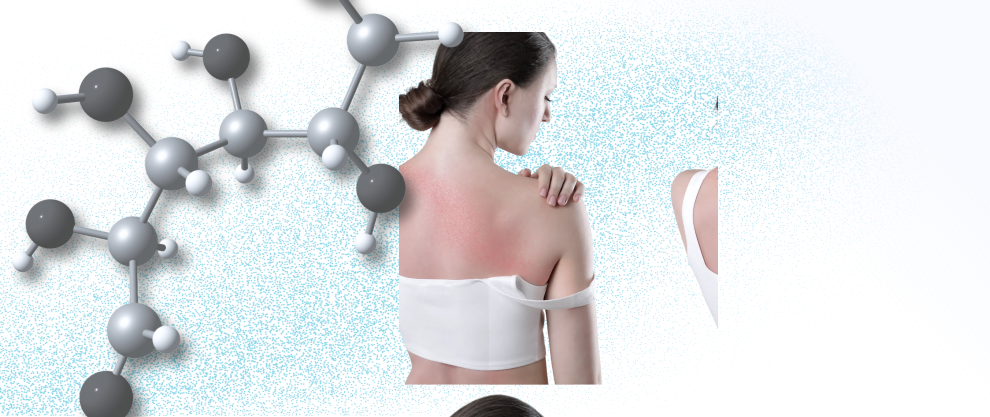



PRED-SKIN integrates multiple QSAR models trained on key events of the Adverse Outcome Pathway (AOP) for skin sensitization. The platform combines in chemico (DPRA), in vitro (KeratinoSens, h-CLAT, U-SENS), in vivo (LLNA), and human (HRIPT/HMT) endpoint models into a consensus prediction system trained on over 1,500 curated compounds.
The Integrated Testing Strategy (ITS) implements OECD 497 Defined Approaches, combining computational predictions with experimental data to provide GHS potency classification. The applicability domain assessment ensures predictions remain within the model's validated chemical space, supporting reliable and transparent results for cosmetic safety assessment and regulatory submissions.


Pred-Skin Predictor
SELECT ANALYSIS MODE
In silico AOP
Prediction of skin sensitization potential based on in silico analysis as Adverse Outcome Pathway (AOP) Key Events.
Partial ITS analysis
Hybrid approach combining U-SENS experimental data with in silico predictions.
Full ITS analysis
Complete OECD 497 Integrated Testing Strategies for highest confidence predictions.
Before you submit
Data handling, curation & privacy
A short, honest note on what PredSkin does and does not do with the chemistry you submit. Please read before running predictions on novel structures.
PredSkin does not perform full chemical standardization on submitted structures. Before predicting, please curate your inputs: remove counter-ions and salts, neutralize charges where appropriate, and select a canonical tautomer. The server applies only basic RDKit canonicalization on the SMILES it receives. Downstream predictions and applicability-domain checks are sensitive to the exact form you submit.
If RDKit cannot parse your structure (malformed SMILES, broken valences, exotic atoms outside the model's training distribution), the request fails with an error message. Always sanity-check inputs in a chemistry editor before submitting. For parseable but chemically unusual molecules, predictions are still returned. Use the Applicability Domain panel in the results to judge whether the prediction is trustworthy.
We do not persist your submitted SMILES, SDF, or MOL data. To accelerate repeated queries we cache results in Redis keyed only by a SHA-256 hash of the canonical SMILES, with a 7-day expiry. The original structure is never written to disk on our side. You can submit novel chemistry with confidence.
The free PredSkin web server predicts a single molecule per submission. SDF and MOL files are read in your browser by the chemistry editor, which loads one structure at a time onto the canvas, so any uploaded file is treated as a single-molecule request. Multi-molecule batch prediction will be available exclusively through our upcoming commercial offering, Insight AI Pro. For early access and pricing, please contact us at carolina@ufg.br.